A New Direction for Advanced
Sacred Music Studies in Texas
In August 1952, Ivan Ronald Olson began his duties as the instructor of music at Concordia, the first full-time appointment of a music faculty in the school’s history, representing a significant investment in music. Olson, born in Soldier, Iowa, in 1928, had graduated from the University of Iowa in 1950 with a BA and was a newly minted 1952 graduate of the University of Texas, having studied piano with Dalies Frantz, a student of Schnabel and Horowitz and an occasional movie actor. Olson had taught public school music in Austin and would take over choral duties at Concordia. He also served as organist at First Lutheran Church in Austin. No longer beholden in philosophy to the Addison seminary or its graduates, the Concordia choir repertoire expanded as Olson taught them secular music, music from different cultures, introduced a “rhythm and blues” ensembles, performed medieval mystery plays, and just generally stretched the metaphorical envelope. In 1955, Ronald Trampe was hired as organist and accompanist for Olson’s increasingly ambitious programs.
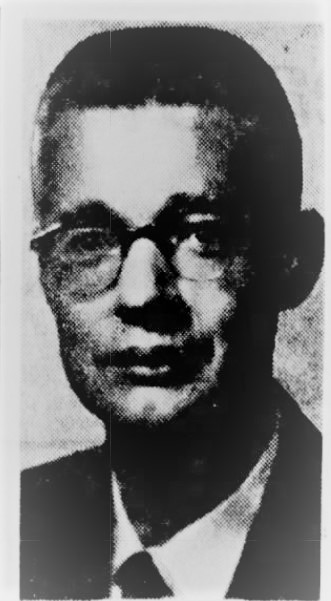
The introduction of coeducation at the college level in the autumn of 1955 provided new opportunities for music, and the mixed Chapel Choir was formed to “sing at daily chapel services and to present daily chapel services and to present programs in church of the surrounding area,” allowing Olson to explore new repertoire.
The completion of Birkmann Chapel in 1952 provided the college with space for corporate worship. Although modest in size, the chapel sported an even more modest choir loft, which at least offered the semblance of reserved choral space. The college commissioned a new organ from the Reuter Organ Company of Lawrence, Kansas, in 1958, which was ready for dedication in 1959.
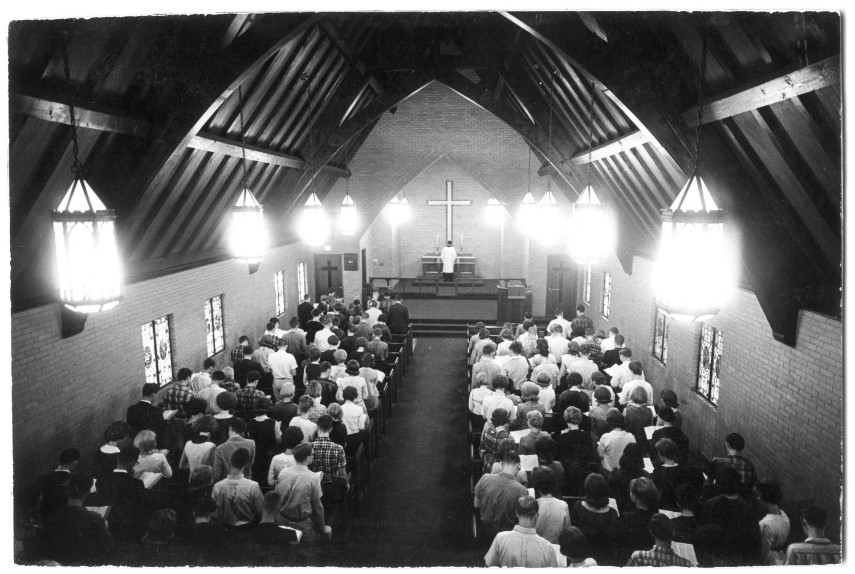
Graduating with his doctorate from Union Theological Seminary in 1964, Olson departed Concordia at the end of the spring semester to teach at American River College in Sacramento. His ambitions had left Concordia with a more active music program than it had ever fielded. Although students were not required to take music classes or keyboard, an increasingly untenable ideal even at the other Concordias as the decades went on, many did acquire their first glimpse of concerted sacred music at the college.
With the arrival of Harold (“Hal”) Rutz in 1964, the college would begin yet another era of renewed vigor. Trained at Concordia Milwaukee and River Forest, Rutz earned a graduate degree from Northwestern University where he studied with Thomas Matthews. (To view his graduate recital or listen to a recording of it, click here.) During Rutz’ over 40-year tenure, he directed the college choirs on innumerable tours, taught countless numbers of organ students, and played organ concerts throughout the state. In 1975, he spent a sabbatical in England, where he studied organ with Peter Hurford at St Alban’s Cathedral.
Click here to hear Rutz performing Bach’s “Wir Glauben all in einem Gott” at Zion Lutheran, Detroit, sometime during the 1950s:

The Concordia Choir singing Carl Schalk’s “Psalm 23” under the direction of Harold Rutz in the spring of 1965:
From the same concert in 1965, from Bach’s motet, “Jesu, Meine Freude,” BWV 227:
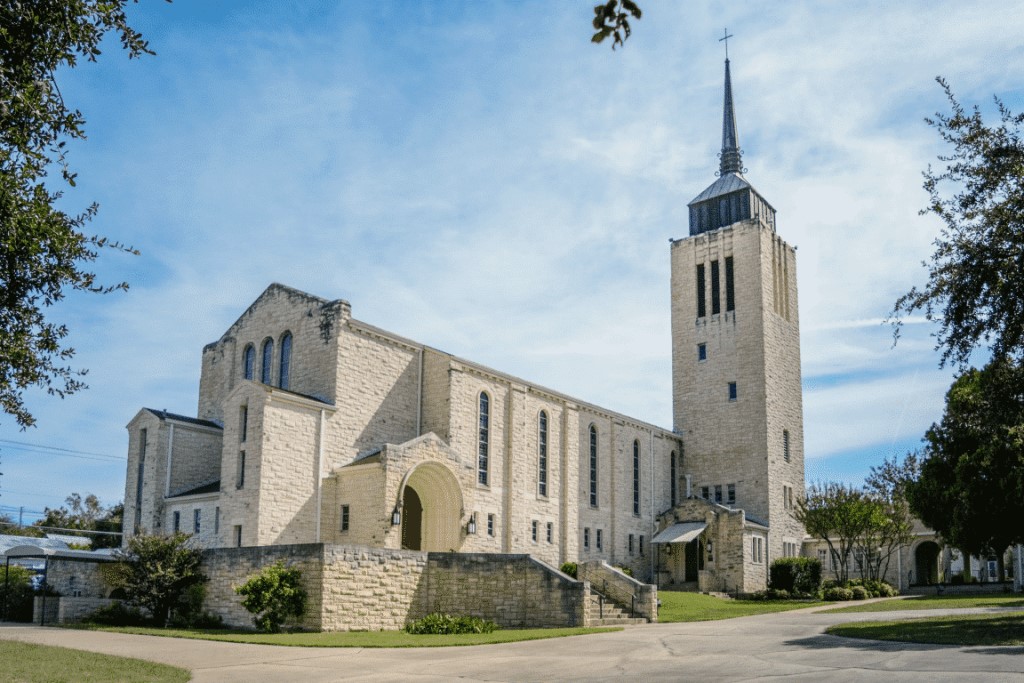
The relationship between St. Paul and Concordia benefitted from the close friendship between Rutz and Bernard (“Bernie”) Gastler, appointed teacher and parish musician at St. Paul in 1963. During Gastler’s tenure at St. Paul, a new Otto Hofmann organ was built, becoming a centerpiece instrument not only for the Austin region, but for the LCMS in Texas. Otto Hofmann himself praised this instrument and the room in which it was placed:
Not often do we have the opportunity to build an organ where
there is a good church building, a strong congregation, and a
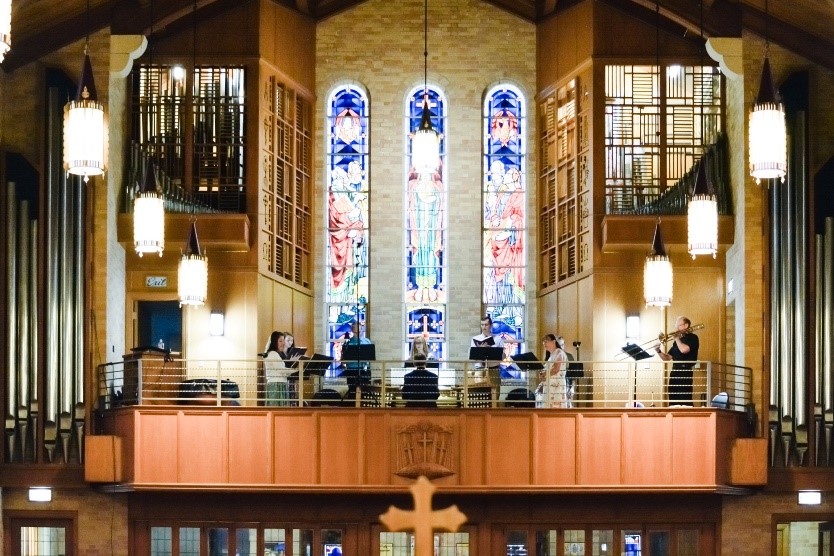
wonderful Lutheran musical heritage, and also have the confidence of knowing of the high quality of the music that will be played on this instrument. With this happy combination we endeavored to build an especially Lutheran organ reflecting such typically Lutheran characteristics as strength, assurance, firmness in one’s belief, compassion, and Christian joy which pours forth in song. With special emphasis on hymn singing in the church, the tonal design of the organ was conceived to bring again congregational hymn singing to that peak which once made the Lutheran worship service unique in the history of the world’s religious . . . music.

The sumptuous acoustics of the Texas Hill Country limestone sanctuary, combined with the careful voicing of this instrument resulted in not only a rich liturgical space, but a wonderful concert venue, and the church hosted many choir and organ concerts through the decades, and continues to do so. Recalling the early arrangement between Concordia and St Paul sharing musicians, in 1982, Concordia hired Gastler as a part-time professor of music. He eventually joined the university to teach music full time.
Hal Rutz performing Buxtehude’s Passacaglia in d minor at St. Paul on 20 February, 1977:
Concordia would transition into a four-year college in the early 1980s, as Rutz and Gastler continued to add to the musical offerings, the highlight of which was the installation of a Schlicker organ in the Louise T. Peter center in 1988. Louise Peter, a descendant of Jan Kilian, donated the money for the arts center, and through all manner of serendipitous blessings, Rutz was able to acquire and install the organ which had been made redundant through the closing of St John’s College in Winfield, Kansas.

At Rutz’ instigation, Concordia offered summer church music workshops from 1988 until 2008, drawing church musicians from across the Southwest for a time of learning and fellowship. Concordia transitioned into a new era with the establishment of a new campus in 2008. The sacred music legacy of those earlier decades lives on in the many graduates who still serve the church in various capacities, musical or otherwise.
Click here to hear the Concordia choir sing “Lo, How a Rose” during their Christmas concert in 1990:
 JoyfulSingingBook